We earn a commission if you buy through our links, at no extra cost to you.
Comparison
Best Humanoid Robots You Can Buy in 2026
Eight humanoid robots you can order from Amazon in 2026, from Unitree's walking G1 and R1 Air to Robosen collectibles and Hiwonder kits, ranked by who each suits.
B By the Best Humanoid Robots editorial team ·Published
At a glance
For the closest thing to a real humanoid, start with the Unitree G1, a closed 23-joint walker for demonstrations. The Unitree R1 Air is the smaller, lighter option, the Robosen Optimus Prime Flagship is the transforming collectible, and the Hiwonder AiNex is the pick for learning to program.
The honest answer to “can I buy a humanoid robot?” is that the phrase covers three very different things on Amazon in 2026. We did not handle any of these machines. We compared the specs on each maker’s official page, read the sources listed at the end and ranked eight models by who each one suits. Where a maker does not state a figure, we say so.
A word about the headline humanoids first. Tesla’s Optimus, Figure’s robots and 1X’s NEO get most of the attention, but they are not Amazon products, so they are not ranked here. This list covers what you can actually order today.
The Three Families
Real humanoids from Unitree. The Unitree G1 and R1 Air are walking, balancing humanoids with joints in the legs, arms and, on the G1, the waist. Both are listed in Unitree’s Amazon brand store; the G1 has been sold there since February 2026, and the R1 Air’s availability is worth checking on the listing. The versions listed there are closed systems, with secondary development reserved for the separate EDU models that Unitree sells through its sales team. They are the nearest thing to a “real” humanoid you can buy this way, and they are heavy machines for adults.
Collector robots from Robosen. The Optimus Prime Flagship, Megatron G1 and Buzz Lightyear are licensed characters that walk, talk and, in the first two, transform on their own. They have servos, apps and programming modes, and they are made for fans, shelves and storytelling, not for tasks.
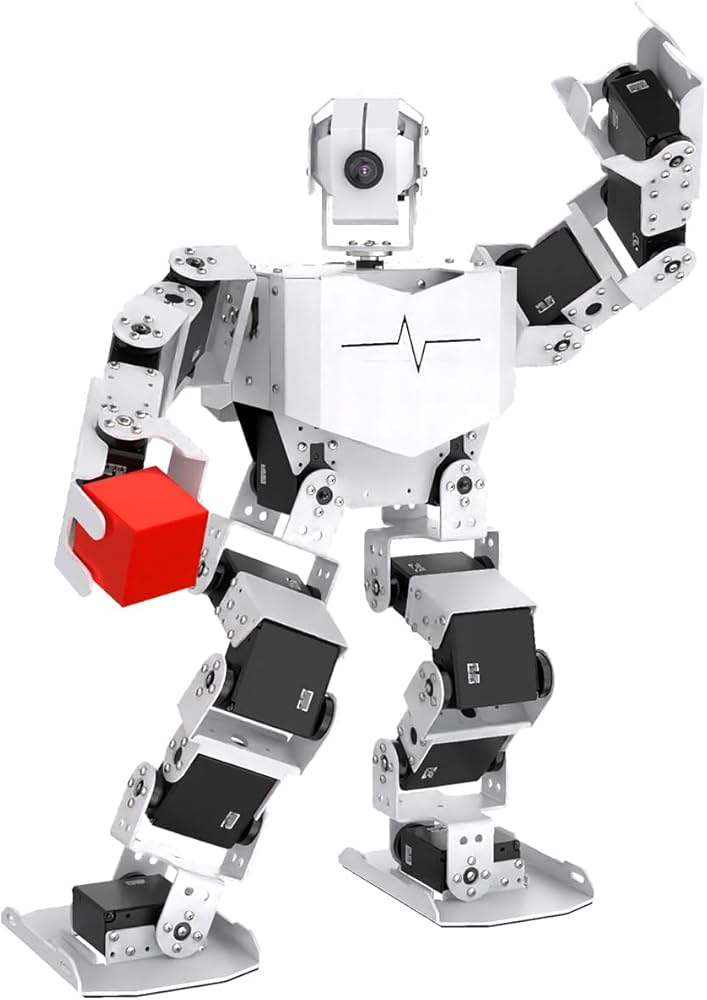
Programmable kits from Hiwonder. The AiNex, TonyPi Pro and Tonybot Ultimate are desktop-sized humanoids you assemble and program. They are the way to learn robotics: Python, ROS, vision and voice, with open source code and tutorials.
How We Ranked Them
We ranked the main list by how much real humanoid capability a buyer gets, with the biggest and most capable machines first, so the Unitree robots lead and the simplest kit comes last. Five questions drive the order:
Is it a real walking humanoid? Size, joints and balance matter most.
Is it open? Can you run your own code, or is it a closed, preset-driven product?
What does it do out of the box? Remote control and presets, voice, vision, transformation or nothing until you program it.
Who is it for? Collectors, learners, demonstrators or developers.
What does safety ask of you? Weight, space, supervision and the age on the listing.
None of these robots is a household helper. If a listing or a video suggests otherwise, treat it as marketing until the maker states it in writing.
Comparison Table
#
Model
Family
Largest Dimension
Open to your code?
Best for
1
Unitree G1
Real humanoid
52 in (1,320 mm)
No (EDU only)
Demonstrations and display
2
Unitree R1 Air
Real humanoid
48 in (1,230 mm)
No (EDU only)
A smaller walking humanoid
3
Robosen Optimus Prime Flagship
Collector robot
19.0 in (48.3 cm)
Moves and voice only
Transformers fans
4
Robosen Megatron G1
Collector robot
20.6 in (52 cm)
Moves and voice only
Decepticon collectors
5
Hiwonder AiNex
Programmable kit
16.3 in (415 mm)
Yes (Python, ROS)
ROS learners and makers
6
Hiwonder TonyPi Pro
Programmable kit
14.7 in (373 mm)
Yes (Python, OpenCV)
AI vision projects
7
Robosen Buzz Lightyear
Collector robot
14.7 in (37 cm)
Moves and voice only
Toy Story fans
8
Hiwonder Tonybot Ultimate
Programmable kit
15.1 in (383 mm)
Yes (Arduino, Scratch, Python)
First-time builders
Sizes come from the makers’ own pages and show the largest dimension each maker lists. The Hiwonder AiNex figure is the Standard Kit size.
According to Unitree, the G1 stands about 52 in (1,320 mm) tall, folds to about 27 in (690 mm), weighs about 77 lb (35 kg) and has 23 degrees of freedom, a depth camera, 3D LiDAR and a quick-release battery rated for about 2 hours. Humanoids Daily reported on February 19, 2026 that the Amazon listing is the “No Secondary Development” version, controlled by a remote or an app with preset behaviors such as dancing and basic walking.
It ranks first because nothing else here is a full-size walking humanoid with this much hardware. The catch is the closed system: if you want to write code on the robot you need the G1 EDU, which Unitree sells separately. Read our Unitree G1 profile before ordering.
Unitree lists the R1 Air at about 48 in (1,230 mm) and about 60 lb (27 kg), with 20 degrees of freedom, a monocular camera, about 1 hour per battery and a 6-month warranty. It leaves out the waist and head joints that the R1 has, and secondary development is listed only for the R1 EDU.
It is second because it is a real humanoid in a smaller body, but with fewer joints and a shorter battery figure than the G1. Choose it for space and weight, not for capability. Details are in our Unitree R1 Air profile.
3. Robosen Optimus Prime Flagship — The Transforming Showpiece
Robosen lists 27 servo motors, more than 5,000 components, a 19.0-inch robot form, Peter Cullen’s voice with 49 voice commands on the 2026 Edition, app control and five programming modes. Robosen says the original 2022 release was a limited Collector’s Edition and the 2026 Edition adds USB-C charging and extra voice commands, so check which one the listing is.
It sits third because it is the most polished of the collector robots, but it performs the routines Robosen designed. If you want a transforming truck, this is the one. See our Optimus Prime Flagship profile.
Robosen lists 36 servo motors, a 20.6-inch robot form, 8.4 lb (3.8 kg), 112 LEDs, two touch zones and more than 270 lines recorded by Frank Welker. The Amazon listing shows ages 12 and over.
It ranks just behind the Optimus Prime because the two are close in concept and the Optimus is the better-known pairing. Megatron is the larger, heavier robot. Our Megatron G1 profile has the details.
Hiwonder describes the AiNex as an AI humanoid built on the Robot Operating System, with a Raspberry Pi controller, a 120-degree wide-angle camera on a 2-DOF head, Python programming, a visual action editor and an 11.1V 3,500 mAh battery. It lists 20 degrees of freedom on the Starter Kit and 24 on the Standard Kit.
It is fifth because it is a desktop kit, about 16 in (415 mm) tall, not a full-size humanoid. But it is the best choice here for anyone who wants to learn real robotics. See the Hiwonder AiNex profile.
According to Hiwonder, the TonyPi Pro has 18 degrees of freedom plus 2 from open-close hands on the Pro kit, a body of about 14.7 x 7.3 x 4.2 in (373 x 186 x 106 mm) that weighs about 4 lb (1.8 kg), an 11.1V 2,000 mAh battery with about 60 minutes of working time, and OpenCV and MediaPipe vision for color, tag and face recognition.
It ranks sixth because it is smaller and simpler than the AiNex in its body, though friendlier for AI experiments. Our TonyPi Pro profile covers it in full.
7. Robosen Buzz Lightyear — The Friendliest Collector Robot
Robosen lists a 14.7-inch figure with 23 servo motors, an 11.1V 1,900 mAh battery with about 60 minutes of runtime, 34 voice commands, more than 200 audio clips, Wi-Fi and Bluetooth 5.0. Easy Creation lets you pose Buzz by hand and save the move, and Robosen Studio handles scripting. The Amazon listing says it is designed for ages 15 and over.
It is seventh because it does not transform and is the smallest of the Robosen trio, but it is the easiest to program. See the Robosen Buzz Lightyear profile.
8. Hiwonder Tonybot Ultimate — The First Humanoid Kit
Hiwonder lists 17 joints, a body of about 15.1 x 7.5 x 4.1 in (383 x 190 x 105 mm) and about 4 lb (1.8 kg), an 11.1V 2,000 mAh battery, an ESP32 expansion board and, on the Ultimate kit, a large AI module with built-in vision and voice. Voice recognition covers predefined phrases and works up to about 16 ft (5 m) in quiet settings and about 3 ft (1 m) in noisy ones, according to the page.
It is last only because it is the simplest of the eight. For a student or a first-time builder who wants Scratch and Arduino as well as Python, it may be the right place to start. See our Tonybot Ultimate profile.
Which One for Which Buyer?
A real humanoid to show people: the Unitree G1, or the R1 Air if space and weight matter more.
A Transformers collector: the Robosen Optimus Prime Flagship, and the Megatron G1 if you want the pair.
A Toy Story fan: the Robosen Buzz Lightyear.
Learning robotics seriously: the Hiwonder AiNex.
AI vision and voice projects: the Hiwonder TonyPi Pro.
A first programmable humanoid: the Hiwonder Tonybot Ultimate.
A humanoid for housework: none of these. Do not buy one for chores.
If you want to run your own code on a Unitree robot, the Amazon versions are not the route. Ask Unitree about the G1 EDU and R1 EDU.
Safety, Space and Age
Weight and strength vary hugely across this list. The G1 is about 77 lb (35 kg) and the R1 Air about 60 lb (27 kg), and Unitree’s G1 page tells owners to keep a safe distance and to use caution because the robot is powerful. Treat both as adult machines, with a clear, flat floor and no children or pets nearby. The Robosen figures are lighter, but Megatron weighs 8.4 lb (3.8 kg) and Optimus Prime about 6.1 lb (2.8 kg), and all three have moving joints, so keep them on a sturdy surface. The Hiwonder kits involve assembly and small parts, so supervise younger builders.
Always read the age on the Amazon listing. Ages on those listings range from 12 and over for the Megatron to 15 and over for Buzz Lightyear and 18 and over for the R1 Air, and several makers do not state an age on their own pages.
Conclusion
If you want a humanoid that stands, walks and looks like the future, the Unitree G1 and R1 Air are the real thing, but the Amazon versions are closed and meant for demonstration. If you want a spectacle that transforms, the Robosen collectibles are the best at it. And if you want to learn, the Hiwonder kits give you open software and tutorials. Pick the family first, then the model.
Yes, with limits. Unitree lists the G1 and the R1 Air in its Amazon brand store (check the R1 Air's current availability on the listing), and both listed versions are closed to secondary development. Beyond those two, what Amazon sells are licensed collector robots from Robosen and programmable kits from Hiwonder.
Which humanoid robot can do household chores?
None of the eight on this list does housework reliably. Unitree's standard G1 and R1 Air are demonstration machines, the Robosen robots are collectibles and the Hiwonder robots are learning kits. Humanoids built for the home, such as 1X's NEO, are announced products, not Amazon listings.
Which one is best for learning to program a humanoid?
The Hiwonder AiNex, with its ROS support and Python, is the deepest learning platform. The TonyPi Pro adds an AI vision and voice layer, and the Tonybot Ultimate is the gentlest start, with Scratch and Arduino as well as Python.
Can I run my own code on the Unitree G1 or R1 Air from Amazon?
No. Unitree lists secondary development for the G1 EDU and the R1 EDU only. The G1 sold on Amazon is the 'No Secondary Development' version, and the R1 Air is not listed for it. Contact Unitree for the EDU versions.
Are these robots safe for kids?
Check the age on each listing. Unitree's robots are heavy, powerful machines for adults, with the Amazon R1 Air listing showing 18 and over. Robosen's Buzz Lightyear listing shows ages 15 and over and the Megatron lists 12 and over. Hiwonder's kits involve assembly, coding and small parts and suit teens with supervision.
What is the difference between a collector robot and a humanoid platform?
A Robosen robot performs the moves and voice lines its maker built, though you can arrange your own sequences. A platform like the Hiwonder kits or the Unitree EDU models is meant to run your own software. The standard G1 and R1 Air from Amazon sit in between: real humanoids, but closed.